
FBG-driven simulation for virtual augmentation of fluoroscopic images during endovascular interventions
Written by: Valentina Scarponi, Juan Verde, Nazim Haouchine, Michel Duprez, Florent Nageotte, and Stéphane Cotin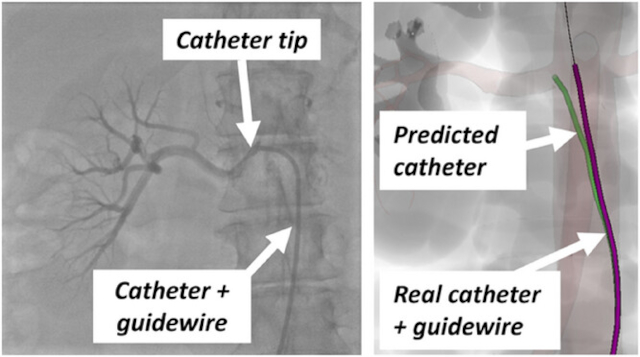 Published on:
 Summary
Endovascular interventions are procedures designed to diagnose and treat vascular diseases, using catheters to navigate inside arteries and veins. Thanks to their minimal invasiveness, they offer many benefits, such as reduced pain and hospital stays, but also present many challenges for clinicians, as they require specialized training and heavy use of X-rays. This is particularly relevant when accessing (i.e. cannulating) small arteries with steep angles, such as most aortic branches. To address this difficulty, a novel solution that enhances fluoroscopic 2D images in real-time by displaying virtual configurations of the catheter and guidewire is proposed. In contrast to existing works, proposing either simulators or simple augmented reality frameworks, this approach involves a predictive simulation showing the resulting shape of the catheter after guidewire withdrawal without requiring the clinician to perform this task. This system demonstrated accurate prediction with a mean 3D error of 2.4 ± 1.3 mm and a mean error of 1.1 ± 0.7 mm on the fluoroscopic image plane between the real catheter shape after guidewire withdrawal and the predicted shape. A user study reported an average intervention time reduction of 56% when adopting this system, resulting in a lower X-ray exposure.
Publication
- Scarponi, V., Verde, J., Haouchine, N., Duprez, M., Nageotte, F., & Cotin, S. (2024). FBG-driven simulation for virtual augmentation of fluoroscopic images during endovascular interventions. Healthcare Technology Letters, 11(6), 392-401. doi: 10.1049/htl2.12108 .
Citation
@article{https://doi.org/10.1049/htl2.12108,
	author = {Scarponi, Valentina and Verde, Juan and Haouchine, Nazim and Duprez,
    Michel and Nageotte, Florent and Cotin, Stéphane},
	title = {{FBG}-driven simulation for virtual augmentation of
    fluoroscopic images during endovascular interventions},
	journal = {Healthcare Technology Letters},
	volume = 11,
	number = 6,
	pages = {392-401},
	keywords = {biomedical imaging, finite element analysis, image enhancement, optical sensors},
	doi = {10.1049/htl2.12108},
	year = 2024
}