
DTHE (Dual Tomograph for High Energy) by RX Solutions
Overview
The Dual Tomograph for High Energy (DTHE) is a unique laboratory X-ray computed tomography system hosted at INSA Lyon and operated by the MateIS laboratory.
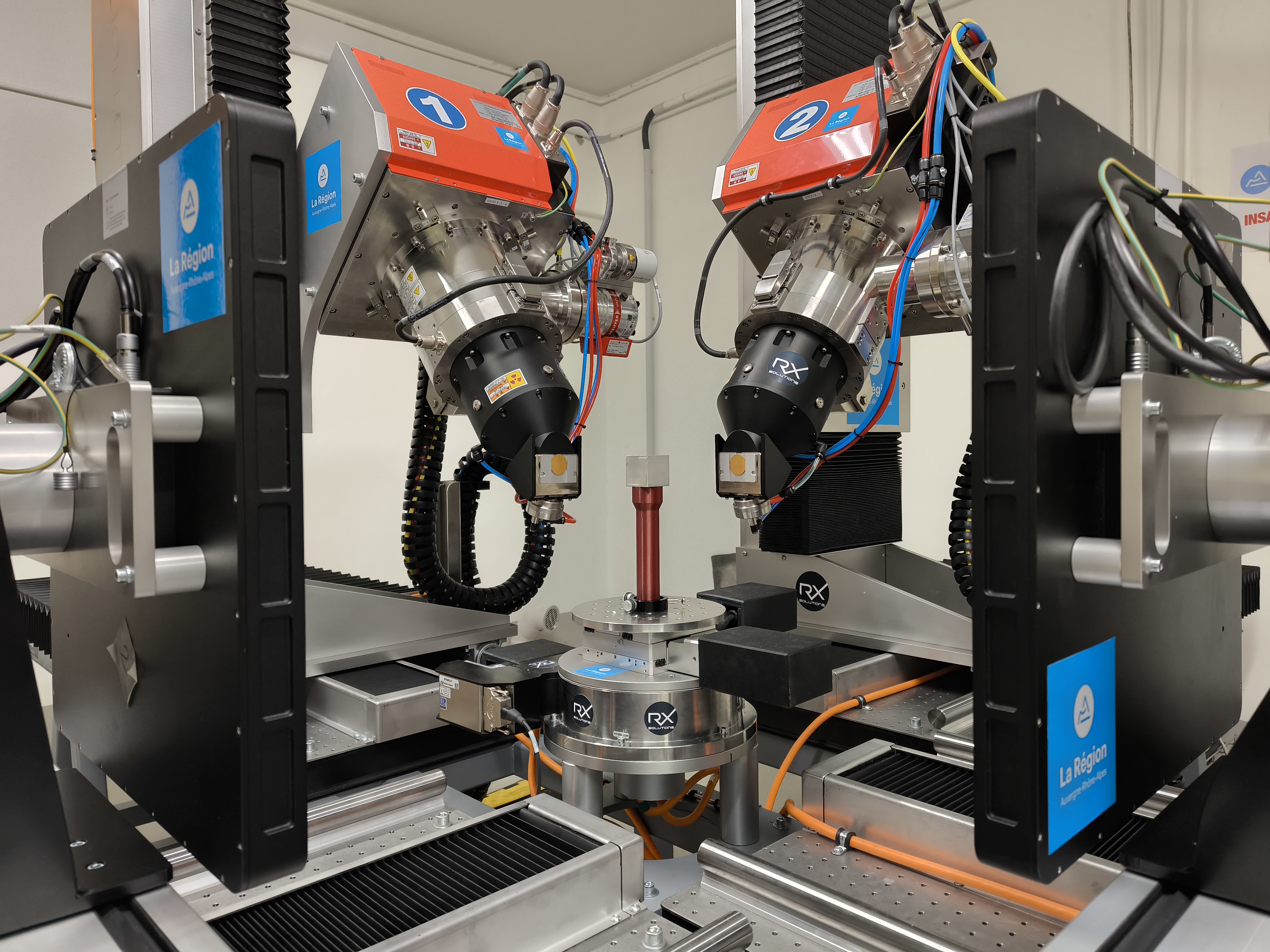
Unlike conventional XCT systems, DTHE consists of two independent high-energy tomography lines mounted at 90° around a shared rotation stage. This unusual configuration enables simultaneous imaging of the same specimen using different imaging parameters such as tube voltage, filtration, magnification, and exposure time.
Beam Characteristics
| Property | Value |
|---|---|
| Source type | Microfocus X-ray tube |
| Beam geometry | Cone beam |
| Target material | Tungsten (W) |
| Target angle | 12° |
| Tube voltage range | 60–260 kV |
| Tube current range | 50–500 μA |
Scientific Applications
The DTHE system is particularly suited to research involving:
- Materials science research
- Industrial inspection
- Additive manufacturing
- Metals and alloys
- Composite materials
- High-density engineering materials
- Multi-scale tomography
- Multi-energy tomography
- Beam-hardening studies
- Imaging protocol optimisation
The dual-line design enables comparative acquisitions under different conditions, making DTHE particularly valuable for investigating the influence of imaging parameters on image quality, artefact formation, and reconstruction accuracy.
Twin Fidelity
Unlike a purely geometrical representation, the DTHE digital twin includes experimentally measured and calibrated parameters:
- Calibrated tube flux model
- Source filtration
- Detector line spread function (LSF)
- Detector gain model
- Detector energy response
- Mechanical positioning constraints
- Variable tube voltage and current
- Multiple detector acquisition modes
These models allow realistic simulation of image quality, blur, detector response, and acquisition statistics observed on the physical system.
X-ray Source
X-ray Tube
| Property | Value |
|---|---|
| Type | Tungsten microfocus tube |
| Geometry | Cone beam |
| Voltage range | 60–260 kV |
| Current range | 50–500 μA |
| Target material | W |
| Target angle | 12° |
Inherent Filtration
| Material | Thickness |
|---|---|
| Aluminium | 0.5 mm |
| Carbon | 4 mm |
Available External Filtration
| Material | Available Thicknesses |
|---|---|
| Copper | 1, 2, 3, 4 mm |
| Molybdenum | 0.2–1.0 mm |
| Silver | 0.125–0.625 mm |
Flux Model
The digital twin incorporates a calibrated flux model derived from experimental measurements. Flux is computed as a function of tube voltage and exposure conditions, enabling realistic noise simulation and acquisition planning.
Detector Model
The digital twin includes a detector model calibrated from experimental measurements.
Detector Characteristics
| Property | Value |
|---|---|
| Maximum resolution | 2880 × 2880 pixels |
| Pixel pitch | 150 μm |
| Scintillator | Gd₂O₂S DRZ-Plus |
| Scintillator thickness | 210 μm |
| Line spread function | Measured and modelled |
| Dark-field noise | Not modelled |
Available Acquisition Modes
| Resolution |
|---|
| 2880 × 2880 |
| 1920 × 1920 |
| 1440 × 1440 |
| 1440 × 2880 |
| 1920 × 2880 |
| 960 × 2880 |
| 480 × 2880 |
Available Exposure Times
- 0.067 s
- 0.083 s
- 0.111 s
- 0.167 s
- 0.333 s
- 0.500 s
Detector Gain Model
The detector gain model reproduces the response of the detector electronics through experimentally calibrated gain parameters and ADU conversion factors.
This enables realistic simulation of detector dynamic range and exposure behaviour.
Simulated Effects
- Detector blur (LSF)
- Detector gain
- Quantum noise
- Scintillator response
- Tube spectrum generation
- Source filtration effects
Acquisition Geometry
Source Position
| Parameter | Value |
|---|---|
| Source-to-object distance | 0–1000 mm |
Detector Position
| Parameter | Value |
|---|---|
| Object-to-detector distance | 0–1000 mm |
The flexible acquisition geometry enables a wide range of magnifications.
Why This Twin Is Unique
The DTHE digital twin reproduces an unconventional dual-line laboratory tomography instrument in which two independent X-ray systems share a common rotation stage.
This architecture makes it possible to investigate acquisition strategies using different imaging conditions, including variations in energy, filtration, magnification, and exposure settings.
The twin incorporates experimentally characterised detector response, detector blur, source filtration, and acquisition constraints, providing a realistic environment for the development and evaluation of advanced XCT methodologies.
Its unique multi-line design makes it particularly attractive for research into:
- Beam-hardening mitigation
- Acquisition optimisation
- Reconstruction benchmarking
- Synthetic dataset generation
- Machine-learning applications
- Multi-energy imaging workflows
Affiliations
- Institution: INSA Lyon
- Laboratory: MateIS
- Country: France
- Manufacturer: RX Solutions